
For a long time, a college degree was considered the main requirement for getting a good job in India. Students focused on completing graduation, earning good marks and getting a recognised qualification. Today, however, the job market is changing.
Indian employers are increasingly looking at what candidates can actually do. Practical skills, communication, problem-solving ability, digital knowledge, internships and real projects are becoming important parts of recruitment. At the same time, a degree still matters for many jobs and remains an important eligibility requirement.
So, do Indian employers prefer a degree or skills? The practical answer is both, but the importance of each depends on the job and industry.
Why a Degree Still Matters
A degree continues to play an important role in the Indian employment market.
For many positions, employers use educational qualifications as an initial screening criterion. Certain professions and jobs also require specific educational qualifications.
A degree can demonstrate that a candidate has completed formal education and has studied a particular subject.
Degrees are particularly relevant for careers such as:
- Engineering
- Banking
- Finance
- Teaching
- Healthcare
- Law
- Government services
- Research
- Management
- Specialised technical professions
Therefore, it would be incorrect to assume that degrees have become completely unnecessary.
Why Skills Are Becoming More Important
A degree shows what you have studied, while skills can demonstrate what you can actually do.
For example, two candidates may have the same B.Com degree. One candidate only has academic knowledge, while the other also knows advanced spreadsheet functions, accounting software, financial reporting and has completed an accounting internship.
The second candidate may have an advantage because the employer can see practical capabilities.
A 2026 study of Indian HR professionals and hiring managers found that most respondents preferred a combination of academic qualifications and practical skills. The study also reported that many organisations had introduced skill assessments during recruitment.
This shows that the discussion is not simply about replacing degrees with skills. Instead, employers are increasingly looking for candidates who can combine qualifications with practical ability.
What Indian Employers Look For
When hiring a candidate, employers may consider several factors together.
These can include:
- Educational qualification
- Technical skills
- Communication skills
- Practical experience
- Problem-solving ability
- Industry knowledge
- Adaptability
- Teamwork
- Professional attitude
- Willingness to learn
For freshers, employers may not expect extensive work experience. However, they often want evidence that the candidate has developed useful skills and can learn quickly.
Degree vs Skills: Which One Gets You the Job?
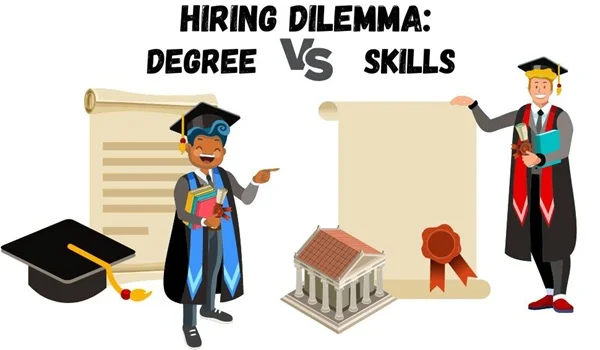
A degree can help you become eligible for a position, but skills can help demonstrate your suitability for the role.
Think of the hiring process this way:
Degree = basic qualification
Skills = ability to perform
Experience or projects = proof
A candidate who has all three can create a stronger profile than someone who depends only on a degree.
This is especially relevant in technology, digital marketing, analytics, design and other practical fields where employers can directly assess a candidate’s work.
Technical Skills Employers Value
The skills you need depend on your career choice.
Technology-related candidates may benefit from learning:
- Programming
- Web development
- Artificial intelligence
- Data analytics
- Cloud computing
- Cybersecurity
- Software testing
- Database management
Business and finance candidates may benefit from:
- Advanced spreadsheet skills
- Accounting software
- Financial analysis
- Business analytics
- Taxation basics
- Data visualisation
Digital marketing candidates may develop:
- Search engine optimisation
- Social media marketing
- Content creation
- Online advertising
- Marketing analytics
- Email marketing
The goal should not be to learn every skill. Instead, choose skills that are relevant to the job you want.
Soft Skills Are Equally Important
Technical knowledge alone does not guarantee employment.
Companies also need employees who can communicate with colleagues, understand customers, solve problems and work effectively in teams.
Important soft skills include:
- Communication
- Teamwork
- Critical thinking
- Problem-solving
- Time management
- Leadership
- Adaptability
- Creativity
- Professional behaviour
For a fresher, strong communication and a willingness to learn can make a significant difference during an interview.
Why Practical Projects Matter
One of the easiest ways for a fresher to prove skills is through projects.
Suppose you claim to know data analysis. Instead of simply writing “Data Analysis” on your resume, you can complete a project using real or publicly available data.
Similarly:
A digital marketing student can create a sample marketing campaign.
A programmer can develop a small application.
An accounting student can prepare a financial analysis project.
A graphic designer can create a portfolio.
A content writer can prepare sample articles.
Projects give recruiters something concrete to evaluate.
Do Internships Matter?
Yes. Internships can help bridge the gap between college education and workplace requirements.
During an internship, students can learn how companies actually operate and gain experience with professional tools and processes.
An internship can also provide:
- Practical experience
- Industry exposure
- Professional contacts
- Better resume value
- Workplace confidence
- Understanding of professional expectations
For freshers, even a short relevant internship can make a resume more useful than a resume containing only academic qualifications.
What About Students From Ordinary Colleges?
Not every student studies at a well-known college. This does not mean that they cannot build a strong career.
Students from lesser-known colleges can strengthen their profiles through practical skills, internships, certifications, projects and professional networking.
For example, a student with an average college background can build a strong profile by combining:
Degree + relevant skills + projects + internship + good communication
Employers ultimately need people who can contribute to the organisation, so practical capability can help candidates stand out.
Is a High Percentage Enough?
Good academic performance is useful, but marks alone may not be sufficient.
A student with excellent marks but no understanding of practical applications may struggle in a skills-based interview.
On the other hand, a student with reasonable academic performance and strong job-related skills may perform well in practical assessments.
This does not mean students should ignore academics. Good marks can help with eligibility and initial screening. The better approach is to maintain academics while simultaneously developing practical skills.
What Freshers Should Do
If you are a college student or recent graduate, do not wait until the final semester to think about employability.
Start by identifying the type of job you want.
Then look at job descriptions for that role and note the skills employers commonly mention.
For example, if you want to become a data analyst, you might focus on spreadsheets, SQL, data visualisation and analytical thinking.
If you want a sales job, focus on communication, negotiation, customer handling and presentation skills.
This makes your learning more career-focused.
Certifications vs Practical Skills
Certifications can strengthen your resume, but a certificate alone does not prove that you can perform a task.
For example, having a certificate in digital marketing is useful, but being able to create and explain a complete marketing campaign provides stronger evidence of your knowledge.
Therefore, whenever possible, combine:
Course + certification + practical project
This gives employers a clearer idea of what you have learned and how you can use it.
How AI Is Changing Employer Expectations
Artificial intelligence is also changing the skills employers expect from candidates.
Many organisations now want employees who can use digital tools effectively, understand new technologies and adapt to changing workflows.
This does not mean every student needs to become an AI engineer.
Instead, candidates should understand how AI and digital tools are relevant to their chosen industry.
For example, a marketing professional may use AI for content research and campaign analysis, while a finance professional may use digital tools for data processing and reporting.
The ability to learn new technology can therefore become an important career advantage.
Can Skills Replace a Degree?
In some careers, skills can open opportunities even without a traditional degree. However, this is not true for every profession.
Some employers may be flexible about formal qualifications for practical roles, while others may consider a degree essential.
Therefore, students should not assume that they can simply skip higher education because skills are becoming more important.
For many people, the strongest strategy remains:
Earn a relevant degree and build practical skills alongside it.
What Employers Prefer in Freshers
When hiring fresh graduates, employers generally want candidates who show potential.
A strong fresher profile can include:
- Relevant educational qualification
- Job-specific technical skills
- Good communication
- Practical projects
- Internship experience
- Problem-solving ability
- Professional attitude
- Willingness to learn
The combination is more powerful than any one factor alone.
Degree vs Skills in Different Careers
The balance between degrees and skills can vary considerably.
IT and Software
Skills such as programming, testing, cloud computing, data and AI can be highly important. Projects and technical assessments may play a major role.
Banking and Finance
Educational qualifications remain important, while financial knowledge, spreadsheets, accounting, analysis and communication can strengthen a candidate’s profile.
Digital Marketing
Practical experience, campaign knowledge, analytics, content skills and measurable project work can be particularly valuable.
Sales
Communication, negotiation, customer handling and confidence can matter significantly alongside educational qualifications.
Teaching
Relevant educational qualifications and subject knowledge are generally important, along with communication and classroom skills.
Engineering
The degree provides the technical foundation, while software knowledge, practical projects, industry exposure and specialised technical skills can improve employability.
The Best Combination: Degree Plus Skills
Instead of choosing between a degree and skills, students should work on both.
Consider these combinations:
B.Com + Excel + accounting software + internship
B.Tech + programming + projects + problem-solving
BBA + communication + sales skills + internship
BA + content writing + digital marketing + portfolio
MBA + business analytics + industry project
Such combinations show employers that the candidate has both formal education and practical capabilities.
Final Thoughts
The debate between degree vs skills is not really about choosing one over the other. In India’s changing job market, employers increasingly want candidates who have relevant qualifications as well as practical abilities.
A degree can help you meet eligibility requirements and enter the recruitment process. Skills can demonstrate your ability to perform the job. Projects, internships and portfolios can provide evidence of those skills.
For Indian students and freshers, the smartest approach is to complete a useful qualification, develop job-ready skills, gain practical experience and continue learning.
In simple terms, a degree may help open the door, but your skills, attitude and ability to demonstrate what you can do can make a strong difference in getting selected.