
Almost every Indian family faces this question at some point — “Should I invest in gold or put my money in a fixed deposit?”
For decades, gold has been an emotional and financial asset in India. From weddings to festivals, Indians trust gold not just as jewellery but also as a long-term investment. On the other hand, Fixed Deposits (FDs) are considered one of the safest ways to grow savings without taking major risks.
But in 2026, things are changing. Digital gold, Sovereign Gold Bonds (SGBs), rising interest rates, inflation, and market uncertainty have made investors rethink where they should put their money.
So, which option is actually better — gold investment or FD?
The answer depends on your financial goals, risk appetite, and investment duration. In this article, we’ll compare both options in simple language to help you make a smarter decision.
Gold Investment vs FD: Quick Comparison Table
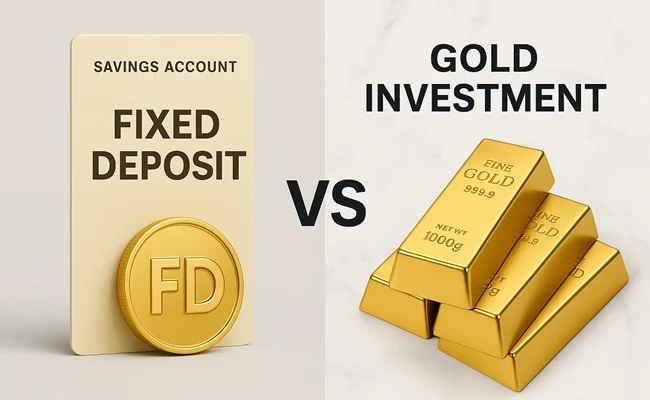
| Feature | Gold Investment | Fixed Deposit (FD) |
| Risk Level | Moderate | Very Low |
| Returns | Market-linked | Fixed |
| Average Returns (2026) | 8%–14% long term | 6.5%–8.5% |
| Liquidity | High | Medium |
| Safety | Depends on type | Very Safe |
| Inflation Protection | Strong | Weak |
| Taxation | Capital gains tax | Interest taxable |
| Ideal For | Wealth growth | Stable income |
| Investment Tenure | Medium to Long | Short to Medium |
| Best For | Aggressive investors | Conservative investors |
What is Gold Investment?
Gold investment means putting your money into gold-related assets to grow wealth over time.
In India, people invest in gold in multiple ways:
Popular Gold Investment Options in India
Physical Gold
- Jewellery
- Coins
- Gold bars
Digital Gold
Available on:
- Google Pay
- PhonePe
- Paytm
Gold ETFs
Gold Exchange Traded Funds traded on stock exchanges.
Sovereign Gold Bonds (SGBs)
Government-backed gold investment scheme by the RBI.
What is a Fixed Deposit (FD)?
A Fixed Deposit is a savings instrument offered by banks and NBFCs where you deposit money for a fixed time and earn guaranteed interest.
Popular FD providers in India include:
- State Bank of India
- HDFC Bank
- ICICI Bank
- Punjab National Bank
FDs remain one of the most trusted investment options among middle-class Indian families.
Key Features and Benefits
Benefits of Gold Investment
- Acts as a hedge against inflation
- Good long-term wealth creator
- High liquidity
- Useful during economic uncertainty
- Can diversify investment portfolio
- Sovereign Gold Bonds offer extra interest income
- Digital gold allows investment starting from ₹10
Benefits of Fixed Deposits
- Guaranteed returns
- Safe and stable investment
- Suitable for senior citizens
- Predictable income
- Flexible tenure options
- Easy to open online
- Loan facility available against FD
Gold vs FD: Returns Comparison in 2026
Gold Returns
Gold prices in India have shown strong growth over the last few years due to:
- Global economic uncertainty
- Inflation
- Rupee depreciation
- Central bank buying
In many cases, gold delivered double-digit returns over long periods.
Example
If you invested ₹1 lakh in gold 5 years ago, the value could have grown significantly depending on market prices.
However, returns are not fixed and prices may fluctuate.
FD Returns
FD interest rates in India during 2026 generally range between:
- 6.5% to 8.5% annually
Senior citizens may get:
- Additional 0.25% to 0.75% interest
Example
₹1 lakh invested in an FD at 7.5% annual interest for 5 years grows steadily without market risk.
But inflation may reduce real returns.
Step-by-Step Guide: How to Invest
How to Invest in Gold
Option 1: Buy Physical Gold
- Visit a trusted jeweller
- Check BIS hallmark certification
- Compare making charges
- Buy invoice-supported gold
Option 2: Invest in Digital Gold
- Open app like Google Pay or PhonePe
- Select digital gold section
- Invest any amount
- Track prices online
Option 3: Buy Gold ETFs
- Open Demat account
- Choose Gold ETF
- Buy through stock exchange
Option 4: Invest in Sovereign Gold Bonds
- Apply through banks or RBI channels
- Complete KYC
- Receive bond certificate
How to Open an FD
- Choose a bank or NBFC
- Compare interest rates
- Select tenure
- Submit KYC documents
- Deposit funds online or offline
- Receive FD confirmation
Most banks now allow instant online FD opening through mobile apps.
Eligibility Requirements
For Gold Investment
- Indian resident
- PAN card for high-value purchases
- Demat account for ETFs
For FD
- Indian residents
- Minors can open with guardians
- Senior citizens eligible for extra interest
Documents Required
| Investment Type | Documents Needed |
| Gold ETF/SGB | PAN, Aadhaar, Bank Account, Demat |
| Physical Gold | ID proof for large purchases |
| FD | Aadhaar, PAN, Address Proof |
Charges and Costs
Gold Investment Charges
Physical Gold
- Making charges
- GST (3%)
- Storage costs
Gold ETF
- Expense ratio
- Brokerage charges
Digital Gold
- Platform charges may apply
SGB
- No storage cost
- No making charges
FD Charges
- Premature withdrawal penalty
- TDS on interest
- Lower liquidity in tax-saving FDs
Pros and Cons
Gold Investment Pros
- Potentially higher returns
- Inflation protection
- Global value asset
- Portfolio diversification
Gold Investment Cons
- Price volatility
- No guaranteed returns
- Jewellery includes high making charges
- Storage and safety concerns
FD Pros
- Capital safety
- Stable returns
- Simple investment process
- Suitable for retirees
FD Cons
- Lower inflation-adjusted returns
- Interest fully taxable
- Limited wealth creation
Who Should Choose Gold?
Gold may suit you if:
- You want long-term wealth growth
- You can tolerate market fluctuations
- You want protection against inflation
- You already have emergency savings
Who Should Choose FD?
FD may be better if:
- You need guaranteed returns
- You are risk-averse
- You are saving for short-term goals
- You are a senior citizen looking for stable income
Best Gold Investment Options in India (2026)
| Option | Best For |
| Sovereign Gold Bonds | Long-term investors |
| Gold ETFs | Stock market investors |
| Digital Gold | Small investors |
| Physical Gold | Traditional buyers |
Best FD Options in India (2026)
| Bank/NBFC | Popular Feature |
| State Bank of India | Government-backed trust |
| HDFC Bank | Strong digital banking |
| ICICI Bank | Competitive FD rates |
| Bajaj Finance | Higher NBFC interest rates |
Common Mistakes to Avoid
While Investing in Gold
- Buying jewellery as pure investment
- Ignoring making charges
- Investing all money in gold
- Not checking purity certification
While Opening FD
- Ignoring inflation impact
- Not comparing interest rates
- Locking funds for very long tenure unnecessarily
- Forgetting tax implications
Expert Tips for Indian Investors
- Don’t invest 100% in one asset
- Use gold for diversification, not full savings
- Keep emergency funds in FD or savings account
- Prefer Sovereign Gold Bonds over jewellery for investment
- Compare post-tax returns before investing
- Senior citizens should explore special FD schemes
Latest Trends in India (2026)
Gold Investment Trends
- Rising interest in digital gold
- SGBs becoming more popular
- Young investors using gold ETFs
- Increased gold demand during inflation
FD Trends
- Higher FD interest rates after RBI policy changes
- Online instant FD booking growth
- Special FD schemes for senior citizens
- Small finance banks offering attractive rates
FAQs
Q: Is gold better than FD in India?
A; Gold can provide better long-term returns, while FD offers safety and fixed income. The better option depends on your financial goal.
Q: Which is safer: Gold or FD?
A; FD is generally safer because returns are fixed and capital protection is higher.
Q: Can gold beat inflation better than FD?
A; Yes, gold usually performs better during inflationary periods compared to traditional FDs.
Q: Are Sovereign Gold Bonds better than physical gold?
A; Yes, SGBs are often considered better because they offer:
- No storage issue
- Additional interest income
- Tax benefits on maturity
Q: Is FD taxable in India?
A; Yes, FD interest is taxable according to your income tax slab.
Q: How much gold should Indians keep in their portfolio?
A; Financial experts generally suggest keeping around 5%–15% of your portfolio in gold.
Conclusion
Both gold and fixed deposits have an important role in financial planning for Indian families.
If your priority is safety, stable returns, and peace of mind, FDs are still a reliable choice in 2026. But if you want better long-term growth and protection against inflation, gold can be a smart addition to your portfolio.
Instead of choosing only one, many financial experts recommend balancing both investments based on your age, income, and financial goals.
A practical strategy could be:
- Keep emergency savings in FD
- Use gold as a long-term wealth protection asset
The smartest investment plan is not about chasing trends — it’s about choosing what fits your financial life realistically.