
Every middle-class family in India has one common dream — a secure future, a comfortable lifestyle, and peace of mind during emergencies. But with rising school fees, expensive healthcare, home EMIs, fuel prices, and lifestyle inflation, managing money has become tougher than ever in 2026.
Many families earn decent salaries, yet still struggle at the end of the month because financial planning is missing. The good news is that personal finance does not require a finance degree. Small, smart decisions can make a huge difference over time.
Whether you are a salaried employee, small business owner, working couple, or single-income family, these practical personal finance tips can help you save more, invest wisely, and build long-term wealth.
Why Personal Finance Matters for Middle Class Families
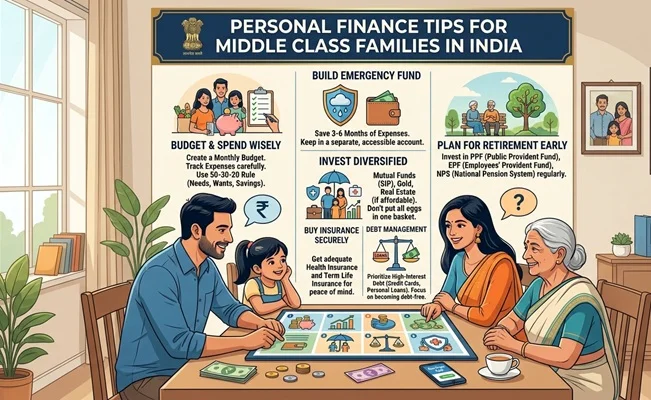
In India, middle-class families often balance multiple responsibilities together:
- Children’s education
- Home loan or rent
- Medical expenses
- Marriage planning
- Retirement savings
- Daily household costs
Without proper money management, even a good salary can feel insufficient.
Good personal finance habits help you:
- Reduce financial stress
- Handle emergencies confidently
- Avoid unnecessary debt
- Build long-term wealth
- Achieve life goals faster
Key Benefits of Smart Financial Planning
Why Financial Discipline is Important
Main Benefits
- Better monthly savings
- Reduced loan burden
- Strong emergency backup
- Peaceful retirement planning
- Financial security for children
- Freedom from paycheck-to-paycheck lifestyle
- Improved credit score
- Better investment returns over time
Step-by-Step Personal Finance Plan for Middle Class Families
1.Track Your Monthly Expenses
The first step is understanding where your money goes.
Use budgeting apps like:
- Walnut
- Money Manager
- ET Money
- CRED Money
- Excel sheet or Google Sheets
Simple Budget Formula
| Category | Recommended Percentage |
| Household Expenses | 50% |
| Savings & Investments | 20% |
| EMIs & Loans | 20% |
| Entertainment & Lifestyle | 10% |
If your expenses exceed income regularly, cut unnecessary spending immediately.
2. Build an Emergency Fund
Unexpected expenses can happen anytime.
Examples:
- Medical emergency
- Job loss
- Car repair
- Family emergency
Ideal Emergency Fund
Save at least:
- 6 months of monthly expenses
Keep this money in:
- High-interest savings account
- Liquid mutual funds
- Sweep-in FD
Example
If your monthly household expense is ₹50,000:
Emergency fund target = ₹3 lakh
3. Buy Health Insurance Early
Medical costs in India are increasing rapidly in 2026.
Even one hospitalisation can destroy years of savings.
Recommended Health Insurance Cover
| Family Type | Recommended Cover |
| Individual | ₹5–10 lakh |
| Family Floater | ₹10–25 lakh |
| Senior Citizens | ₹15 lakh+ |
Popular insurers in India:
- HDFC ERGO
- Star Health
- Niva Bupa
- ICICI Lombard
Do not depend only on employer insurance.
4. Avoid Bad Debt
Not all loans are harmful.
Good Debt
- Home loan
- Education loan
Bad Debt
- Credit card debt
- Buy Now Pay Later (BNPL)
- Personal loans for lifestyle spending
Important Rule
Your total EMIs should ideally stay below 35% of monthly income.
5. Start SIP Investments Early
Many middle-class families delay investing because they think large money is required.
That is false.
You can start SIPs from ₹500 per month.
Best Investment Options in India (2026)
| Investment Option | Risk Level | Expected Returns |
| SIP Mutual Funds | Moderate | 10–14% |
| PPF | Low | 7–8% |
| Fixed Deposit | Low | 6–7.5% |
| Gold ETF | Moderate | 8–10% |
| NPS | Moderate | 9–12% |
Best SIP Categories for Long-Term Wealth
- Index Funds
- Flexi Cap Funds
- ELSS Funds
- Large & Mid Cap Funds
6. Plan for Retirement Early
Most Indians start retirement planning too late.
The earlier you start, the less burden you face later.
Example
| Start Age | Monthly Investment Needed for ₹1 Crore |
| 25 years | ₹5,000 approx |
| 35 years | ₹13,000 approx |
| 45 years | ₹32,000 approx |
This shows the power of compounding.
7. Save Tax Smartly
Middle-class families can save significant tax legally.
Best Tax-Saving Options
| Investment | Section | Limit |
| PPF | 80C | ₹1.5 lakh |
| ELSS | 80C | ₹1.5 lakh |
| Life Insurance | 80C | ₹1.5 lakh |
| NPS | 80CCD(1B) | Extra ₹50,000 |
| Health Insurance | 80D | ₹25,000–₹75,000 |
Who Should Follow These Personal Finance Tips?
These tips are useful for:
- Salaried employees
- Working couples
- Government employees
- Small business families
- Freelancers
- Families with children
- Single-income households
Best Financial Habits for Indian Families
Daily Habits That Build Wealth
- Save before spending
- Compare prices online before shopping
- Avoid impulse purchases
- Use cashback and rewards wisely
- Invest monthly without fail
- Review expenses every month
- Avoid showing off lifestyle on EMI
Documents Required for Financial Planning
Although personal finance itself does not require documents, these are important for investments and insurance:
- PAN Card
- Aadhaar Card
- Bank account
- Salary slips
- Income proof
- Address proof
- Passport-size photo
- Nominee details
Charges, Fees & Investment Requirements
Typical Investment Starting Amounts
| Financial Product | Minimum Amount |
| SIP | ₹500 |
| PPF | ₹500 yearly |
| FD | ₹1,000 |
| Health Insurance | ₹8,000–₹25,000 yearly |
| NPS | ₹500 |
Pros and Cons of Financial Planning
Pros
- Better financial security
- Reduced stress
- Long-term wealth creation
- Improved retirement life
- Better future for children
Cons
- Requires discipline
- Results take time
- Wrong investments can cause losses
- Emotional spending habits are hard to control
Common Money Mistakes Middle Class Families Should Avoid
No Emergency Fund
Many families invest first but forget emergency savings.
Depending Only on FD
FDs are safe but may not beat inflation in the long run.
Overspending on Lifestyle
Expensive phones, luxury bikes, and unnecessary gadgets can destroy savings.
Ignoring Insurance
Insurance is protection, not an expense.
Delaying Investments
Time matters more than investment amount.
Expert Personal Finance Tips for 2026
Best Advice for Indian Families
Automate Savings
Set auto-debit SIPs and recurring deposits.
Increase Investments with Salary Hike
Whenever salary increases, increase SIP amount too.
Avoid Too Many Credit Cards
Use only 1–2 cards responsibly.
Teach Children About Money
Financial education should start early.
Diversify Investments
Do not put all money into one investment type.
Latest Financial Trends in India (2026)
- Rising Popularity of Index Funds
Low-cost index investing is growing rapidly in India.
- Digital Gold Investments
Many investors now buy digital gold through apps.
- AI-Based Budgeting Apps
Smart apps now automatically track spending habits.
- Higher Health Insurance Awareness
Post-pandemic awareness continues to increase.
- Women-Led Financial Planning
More Indian women are actively managing family finances.
Best Personal Finance Apps in India
| App | Best For |
| ET Money | Investments & SIP |
| Groww | Beginners |
| Zerodha Coin | Mutual Funds |
| INDmoney | Wealth Tracking |
| CRED | Credit Card Tracking |
FAQs on Personal Finance Tips for Middle Class Families
Q: How much should a middle-class family save monthly?
A: Ideally, save at least 20% of monthly income.
Q: Which is better for middle-class families — FD or SIP?
A: FD is safer, while SIP offers better long-term wealth growth.
Q: How much emergency fund is enough?
A: Keep at least 6 months of expenses saved separately.
Q: Is health insurance necessary if company insurance exists?
A: Yes. Employer insurance may not be enough during major medical emergencies.
Q: What is the best investment for beginners in India?
A: SIP in index mutual funds is considered one of the best beginner-friendly options.
Q: Should middle-class families invest in gold?
A: Yes, but only 5–10% of the portfolio for diversification.
Q: What is the ideal age to start retirement planning?
A: The earlier, the better. Starting in your 20s gives maximum benefit.
Conclusion
Personal finance is not about earning crores. It is about managing whatever income you have wisely. Even small financial habits can create a strong future over time.
For middle-class families in India, the real secret is consistency — regular saving, disciplined investing, controlled spending, and proper protection through insurance.
Start small if needed, but start today. Your future financial stability depends more on habits than income.